

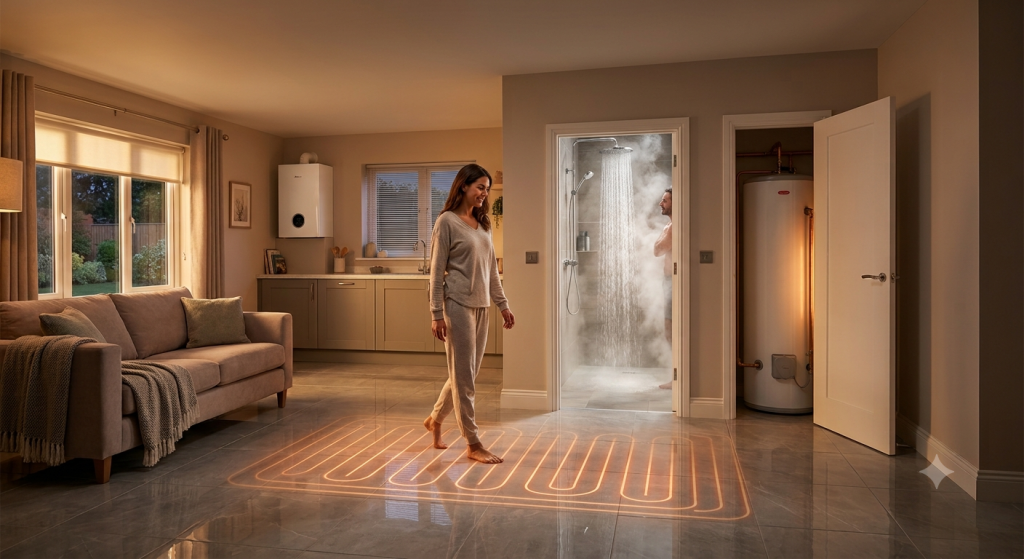
When homeowners plan a renovation, much of the attention naturally goes towards the things they can see: flooring, lighting, furniture, bathrooms and kitchen finishes.
However, some of the most valuable improvements are hidden beneath the floor or behind a cupboard door.
Underfloor heating and an unvented hot water cylinder can fundamentally change how a home feels and performs. One provides consistent, evenly distributed warmth, while the other delivers stronger hot water performance throughout the property.
At PHGS Ltd, we design and install underfloor heating and high-pressure hot water systems for homes across Colchester, Chelmsford, Ipswich and the surrounding areas. Here is how these two upgrades can improve comfort, efficiency and the way you use your home every day.
Why Underfloor Heating Is Becoming More Popular
Underfloor heating is increasingly being included in kitchen extensions, open-plan renovations and new-build properties.
Rather than relying on individual radiators positioned around the room, underfloor heating distributes warmth across a much larger surface area. This creates a more consistent temperature throughout the space and reduces the hot and cold spots often associated with traditional heating systems.
The result is a comfortable, even warmth that is particularly noticeable during colder months.
More Even Heat Distribution
Traditional radiators heat the air immediately around them first. That warm air then rises and circulates through the room.
Underfloor heating works differently. Heat rises gently from across the floor, helping to warm the whole room more evenly.
This can make larger open-plan spaces feel noticeably more comfortable, particularly where radiators may struggle to distribute heat effectively across the entire area.
Lower Operating Temperatures
Underfloor heating can often operate at a lower water temperature than conventional radiator systems because the entire floor becomes a heat-emitting surface.
A properly designed system may typically use flow temperatures of approximately 35°C to 45°C, although the exact requirement depends on the property, insulation levels, flooring and chosen heat source.
This makes underfloor heating particularly well suited to low-temperature heating technologies such as air source heat pumps.
When the system is correctly specified, the lower operating temperature can help the heat source work more efficiently. However, system performance will always depend on the design of the property and the quality of the installation.
Greater Freedom When Designing Your Home
One of the less obvious benefits of underfloor heating is the freedom it can give you when planning a room.
Removing wall-mounted radiators can create more usable space and make it easier to achieve a clean, contemporary layout.
This can be particularly valuable when incorporating:
- Bifold or sliding doors
- Floor-to-ceiling glazing
- Large kitchen units
- Built-in storage
- Flexible furniture arrangements
- Minimalist interior designs
You no longer need to position furniture around radiators or sacrifice valuable wall space to accommodate them.
For extensions and major renovations, underfloor heating can therefore influence both comfort and the overall design of the room.
Is Underfloor Heating Suitable for Every Property?
Underfloor heating can work in many different types of property, but it must be designed around the building rather than treated as a standard product.
Important considerations include:
- The size and layout of the room
- Existing insulation levels
- Floor construction
- Floor finishes
- Heat-loss calculations
- The boiler or heat pump supplying the system
- The number of heating zones required
Floor coverings also make a difference. Tiles and stone conduct heat effectively, while engineered timber, laminate and some carpets can also be suitable when installed within the manufacturer’s specified temperature limits.
A professional survey and heat-loss assessment help determine whether underfloor heating is appropriate and how the system should be configured.
The Benefits of an Unvented Hot Water Cylinder
A comfortable home also needs reliable hot water.
Many older properties use a traditional vented system, with a cold water storage tank in the loft feeding a hot water cylinder. These systems can work well, but they may struggle to provide the water pressure expected by modern households.
An unvented hot water cylinder takes its supply directly from the incoming mains and stores the water under pressure.
When the incoming mains supply is suitable, this can provide a stronger and more consistent flow of hot water throughout the property.
Better Performance for Showers and Bathrooms
Modern bathrooms often include rainfall showers, larger shower heads, freestanding baths and multiple outlets.
These fixtures can require a greater volume of water than an older gravity-fed system can comfortably provide.
A correctly sized unvented cylinder can help deliver:
- Stronger shower performance
- Faster-filling baths
- More consistent hot water pressure
- Improved performance when several outlets are being used
- Reliable hot water for larger households
This can be especially valuable in homes with multiple bathrooms or where several people may need hot water at similar times.
Removing the Need for a Loft Tank
Because an unvented cylinder is supplied directly from the mains, it usually removes the need for a separate cold water storage tank in the loft.
This can free up useful loft space and eliminate some of the common drawbacks associated with traditional tanks, including noise, the risk of freezing and maintenance requirements.
However, an unvented cylinder is not automatically suitable for every home.
Before recommending one, PHGS assesses:
- The incoming mains pressure
- The available water flow rate
- The number of bathrooms and outlets
- The household’s likely hot water demand
- The available installation space
- The property’s existing heating system
An unvented cylinder cannot create more water flow than the mains supply can provide, so proper assessment is essential.
Smarter Heating with Zoned Controls
Modern heating systems can also be divided into separate zones, allowing different areas of the property to operate at different temperatures and schedules.
For example, you may want:
- The kitchen and living space warmer during the day
- Bedrooms cooler overnight
- Guest rooms heated only when needed
- Bathrooms warmed before the morning routine
- Less heating in unused areas of the house
Smart controls can allow these zones to be managed through individual thermostats, programmed schedules or compatible mobile applications.
This gives homeowners greater control over comfort while helping to avoid heating rooms unnecessarily.
The controls must be designed as part of the wider system. The manifold, wiring centre, thermostats, valves and heat source all need to work together correctly.
Why Professional System Design Matters
Underfloor heating and unvented hot water systems require more than simply connecting pipes and equipment.
A successful installation depends on detailed planning, correct sizing and precise commissioning.
For an underfloor heating system, this may include:
- Room-by-room heat-loss calculations
- Pipe-spacing design
- Manifold positioning
- Flow-rate balancing
- Heating-zone configuration
- Floor-temperature limits
- Integration with the boiler or heat pump
For an unvented hot water cylinder, it includes:
- Selecting the correct cylinder capacity
- Assessing mains pressure and flow
- Installing the required safety components
- Configuring expansion and pressure controls
- Testing discharge arrangements
- Commissioning the complete system
Unvented cylinders must also be installed and maintained by suitably qualified professionals.
At PHGS, we do not take a one-size-fits-all approach. We assess the property, understand how the household uses heat and hot water, and design the system around those requirements.
Combining Underfloor Heating and High-Pressure Hot Water
When installed as part of the same renovation, underfloor heating and an unvented cylinder can create a significant improvement in everyday comfort.
Together, they can provide:
- Even, consistent heating
- Greater freedom when designing rooms
- Stronger showers
- Faster-filling baths
- Reliable hot water across multiple outlets
- Better integration with modern heating controls
- A heating and hot water system designed around the household
They are particularly suitable for:
- Kitchen extensions
- Whole-house renovations
- New-build homes
- Multiple-bathroom properties
- Heat pump installations
- Homeowners replacing outdated heating systems
The best results come from considering heating, hot water and controls together rather than upgrading each component in isolation.
Planning a Heating or Hot Water Upgrade?
Whether you are renovating an older property, building an extension or looking to improve an existing heating system, PHGS can help you plan the right solution.
Our team designs, installs, commissions and maintains underfloor heating and unvented hot water systems across Colchester, Chelmsford, Ipswich and the surrounding areas.
We focus on careful specification, precise installation and reliable long-term performance.
Explore our heating and gas services or contact PHGS to discuss your project.
📞 01206 803222
PHGS Ltd: Precision. Reliability. Results